Sheet 03 · Uphill transport · Kings Hill, Lewis & Clark N.F.
One Horse,
Ninety Horsepower
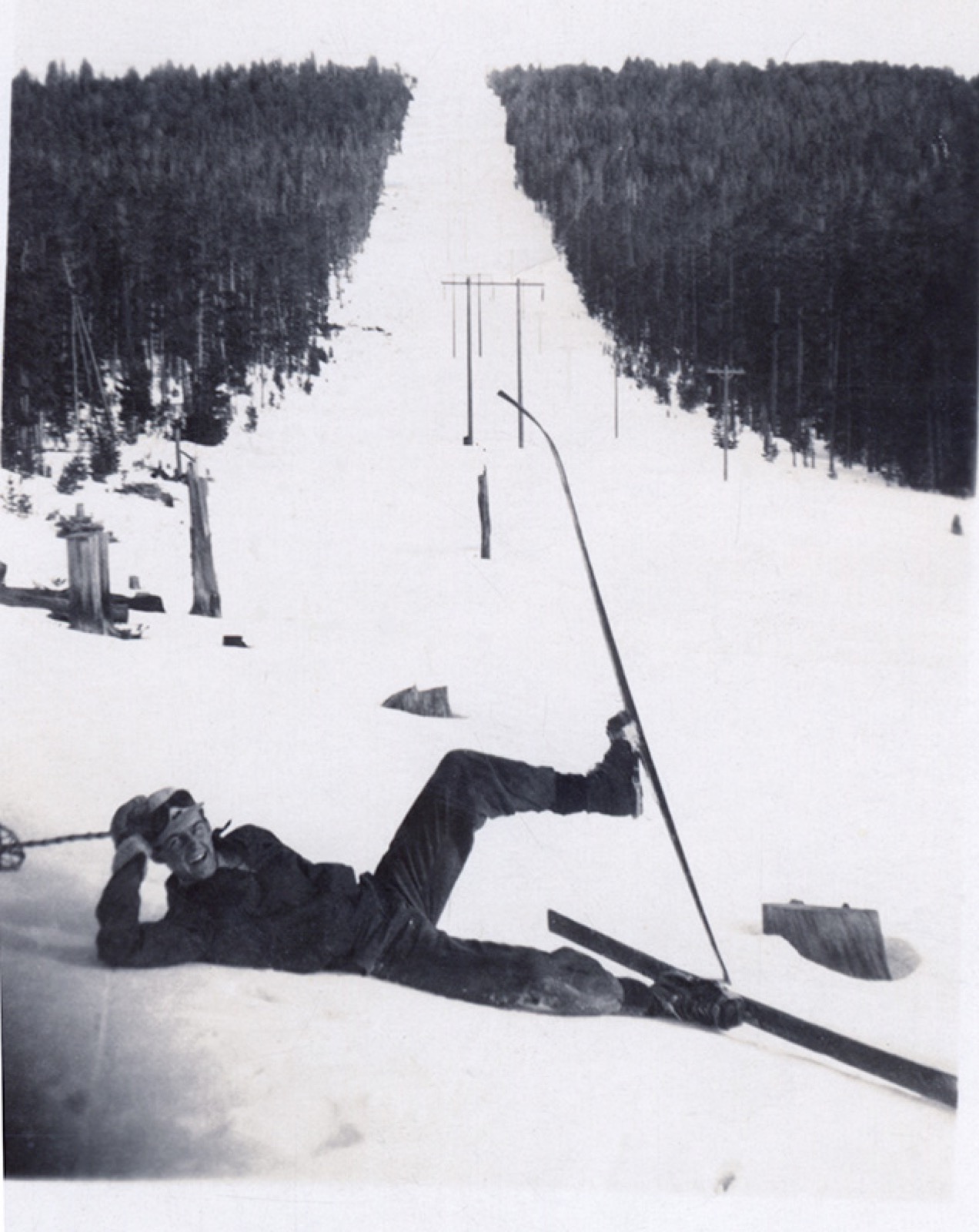
The Great Falls Ski Club built two rope tows on a mountain with no power line, no road to the slope and no money. The engine for the second one went up the hill on skids, a third of a mile, behind a single horse. The lumber for the warming house went up on shoulders.
Schedule of works
| Season | Work | Recorded figures |
|---|---|---|
| 1938 | Bovee (Bovey) Slope laid out — the first run at the Kings Hill site | — |
| Winter 1938-39 | The first ski tow is built. Charles A. Bovey takes personal charge of the installation, assisted by Henry Sheffels, by club members — and by his own ranch hands, who did the physical work. Forestry and CCC officials co-operate | 1,000 ft endless rope Base 200 yds off the highway |
| Winter 1938-39 | A warming house is completed at the course alongside the lift | — |
| Winter 1938-39 | The lift runs for the first time and is photographed for the Tribune | 50¢ a day members $1 non-members |
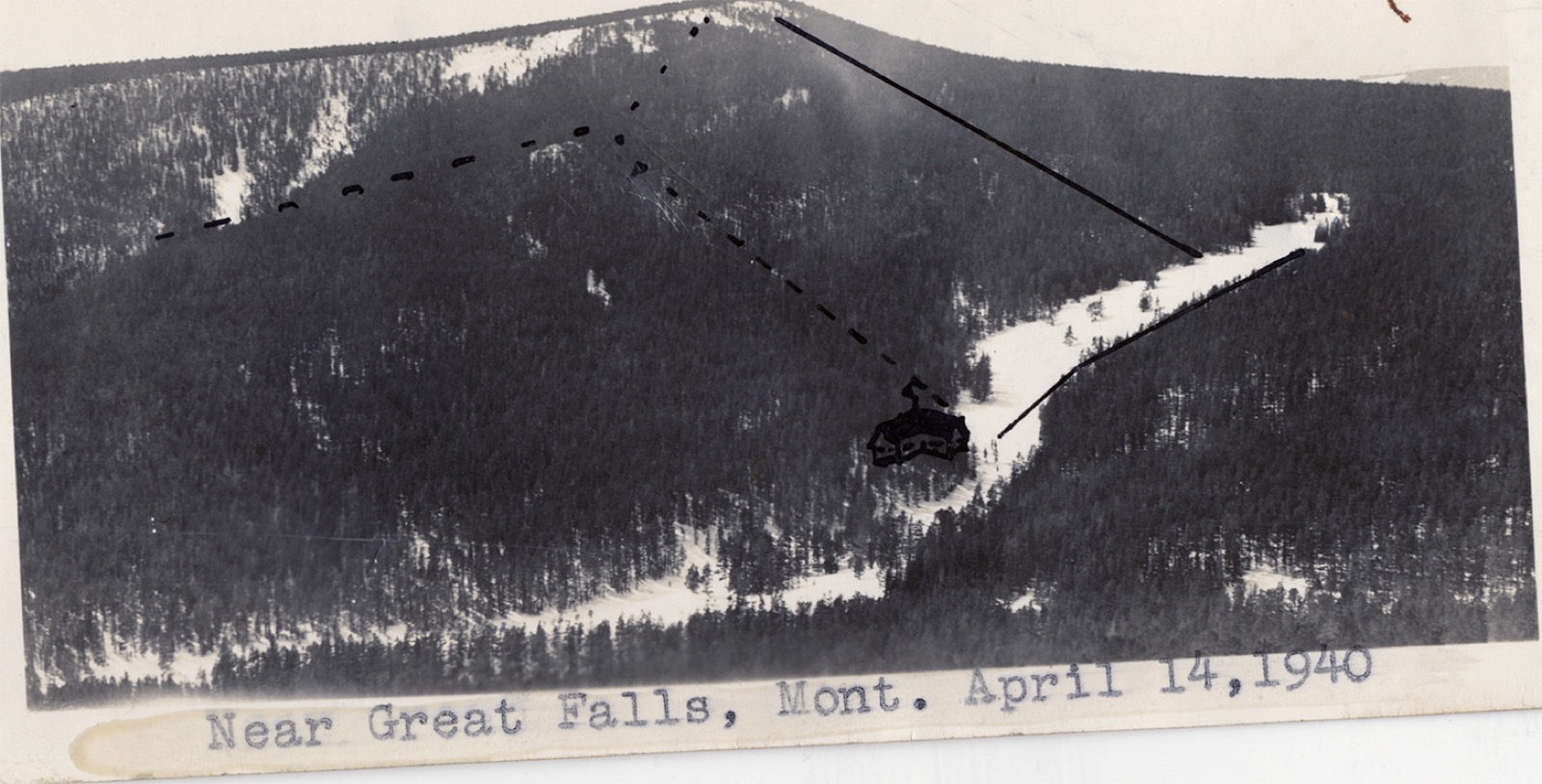
| Fall 1939 | The Forest Service lays out a new run to the top of Porphyry Peak; CCC crews clear it. A printed map is published showing the planned course, a ski tow, and a proposed site for a ski lodge | ¾ mile · 1,400 ft drop Average grade 23% · 25 ft clearing |
| Fall 1939 | A reconditioned automobile engine is hauled a third of a mile up the mountain on skids behind one horse. The lumber for the warming house goes up on the members’ shoulders. A motor house and warming house are built | 90 horsepower |
| Nov–Dec 1939 | The second lift is installed to the top of Porphyry Peak, on the run the club names Prentice Run by resolution c. December 20, in honour of George Prentice | 2,500 ft (2,600 ft as stated in 1940-41) |
| Dec 9-10 1939 | Official opening of the run and the new lift. The full course is announced at 4,400 ft — “but lack of snow may forestall use of the lower run” | 4,400 ft total course |
| Jan 1940 | The Bovey Slope motor is replaced by voluntary subscription — the old one ruined by someone who filled it with water and failed to drain it. Charges are fixed on lift rides; signs are to be erected at each lift | — |
| 1940-41 | The two lifts are stated together for the first time in the federal winter-sports guide Ski West | 1,200 ft and 2,600 ft |
Note A · Running the engine
Starting a tow motor at 7,500 feet in a Montana January was a procedure, not a switch.
The engine block, the anti-freeze and the oil each had to be heated separately before it would start. Gasoline was buried in pits. And the engine had to be replaced after someone left water in it that froze and broke the block.
The same incident appears in the January 1940 clippings and again in a 1988 interview — forty-eight years apart, from two independent directions. Where Throckmorton describes an event rather than a date, he is reliable.
StatedSCRAP-HASTERLIK-01 · NEWS-1988-03-17-TRIBNote B · The packing ticket
There were no groomers. Before anyone skied, a portion of the slope had to be packed on foot, by the skiers themselves.
“After they had taken a turn at packing, the supervisor of the volunteer crew gave them a ticket they had to present when buying a lift ticket.”
Skiing at Kings Hill was labour before it was recreation — and the labour was enforced with paperwork. A ride cost fifty cents for a member. A first ski outfit cost $39.
StatedNEWS-1988-03-17-TRIBRevision notes · what this sheet does not settle
- Tow no. 1 length. Recorded as 1,000 ft when built and 1,200 ft in 1940-41. Either it was lengthened, or one figure is loose. Not resolved.
- Tow no. 2 length. 2,500 ft at installation, 2,600 ft the following season, and “~2,400 ft to the top of Porphyry Peak” in the naming resolution. Same problem.
- The 1934 claim. Ed Schenck’s 1981 obituary says he was “instrumental in building Montana’s first ski lifts at King’s Hill near Neihart in 1934.” The contemporary record has the club founded in 1938 and the first tow completed in 1939. Recorded, not accepted.
- “Montana’s first chairlift.” Not this, and not in this decade. These were rope tows. The first chairlift on this mountain opened November 27, 1970.
- The engine’s origin. A 1996 account says the 90-hp motor came out of an old Buick. The 1930s clippings say only “a reconditioned automobile engine.”